
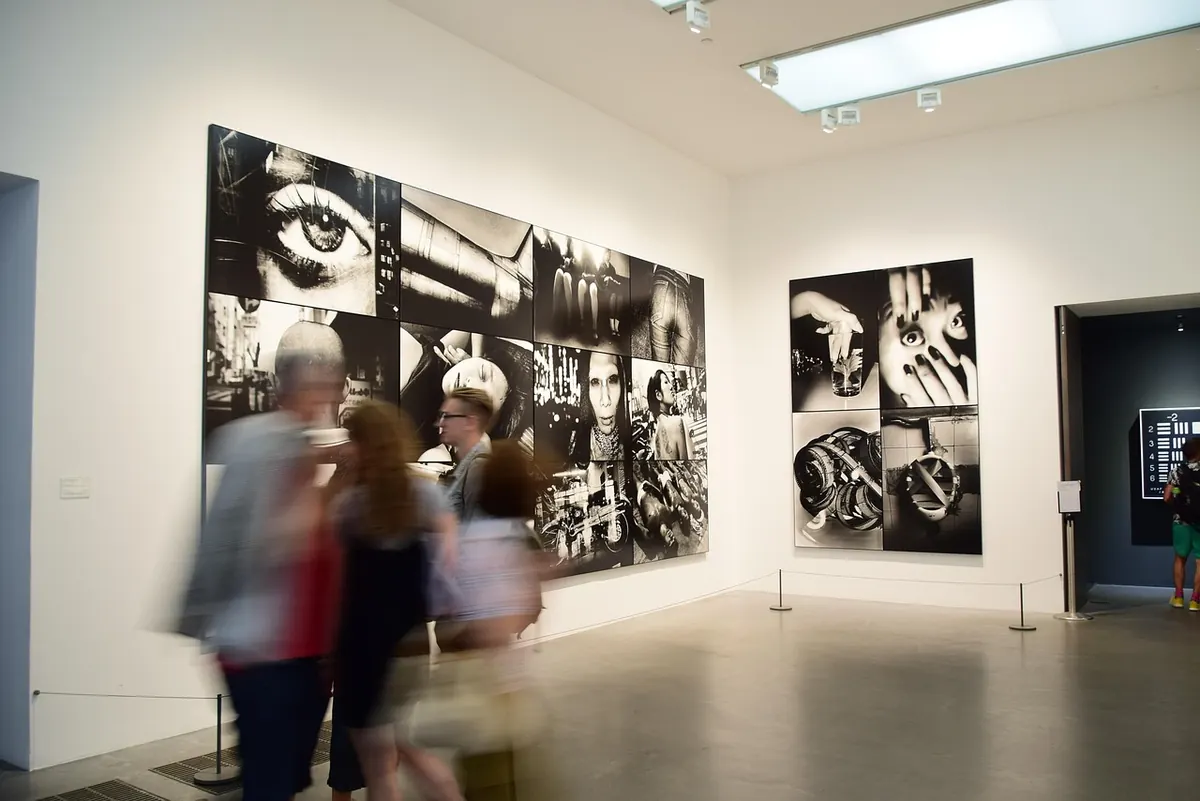
The first time you walk into a First Friday gallery walk, it can feel like everyone else got a map and a schedule and you got a parking spot four blocks away. Elmwood's version is genuinely friendly, but it is also spread out: a handful of blocks, several dozen open doors, and a few hundred people moving through them at the same time. You do not need an elaborate plan. You need a start point, a sense of timing, and permission to walk past the crowded places without feeling guilty about it. Here is how to make your first one good.
Start at the Ends and Work Inward
Most first-timers do the same thing: they park as close as they can to the busiest intersection and start there. That is also what everyone else does. Between the opening hour and about 7:30, the anchor venues near the center are shoulder-to-shoulder, and you spend more time apologizing to strangers than looking at anything.
Do the opposite. Park a few blocks past the middle, near the quieter end of the strip, and walk back toward the crowd as the evening loosens up. You get the smaller spaces while they are still calm, which is when the person behind the table actually has time to talk to you about what you are looking at. By the time you reach the packed rooms, you have seen enough to feel oriented, and you are far less likely to give up and go home early.
Pick a direction and commit to it. The walk is linear enough that doubling back wastes the good part of your evening. Ten to fifteen minutes of walking in each direction is normal, so wear the shoes you would wear to a street fair, not the ones you would wear to a job interview. Sidewalks are uneven, and you will stand far more than you sit.
Timing Is Most of the Strategy
Doors generally open in the late afternoon and things wind down by around nine, but hours shift from month to month, so check the current listing before you head out. The rhythm of the evening, though, is fairly consistent:
- The first hour: the quietest stretch. Best for parking, best for conversations, best for seeing work without leaning over someone's shoulder.
- The middle hours: peak crowd. Great energy, tough sightlines. This is when the popular venues have a line at the door.
- The last hour: the crowd thins, the artists relax, and the people still standing around are usually the ones worth talking to. Some venues end the night with a small gathering.
If you only have ninety minutes, come for the last hour. If you want to buy something and talk to the maker, come for the first one.
The Free Stops Worth Your Time
Not every open door is a gallery, and not every gallery charges you to walk in. Most of the walk is free; the paid part is whatever you decide to take home. Prioritize these:
- Open studio buildings, where several artists share a floor. You see work in progress, which is more interesting than a finished wall.
- Cooperative galleries, usually run by the artists themselves. Smaller, warmer, and rarely crowded at the start of the night.
- Pop-ups in empty storefronts. These are one-month-only by nature, so they are the part of the walk that will not exist next year.
- Sidewalk tables and demonstrations. Free, quick, and a good way to break up the walk between bigger stops.
Some venues ask for a donation at the door or sell raffle tickets to fund the space. That is different from an admission fee, and a couple of dollars is a reasonable way to say thanks. Most places take cards now, but a little cash saves you a detour when a table does not.
What to Skip on Your First Visit
You are allowed to leave a room. Give it two minutes; if nothing holds your attention, walk out and move on. Nobody is keeping score, and the best part of the night is usually two doors down.
Also worth skipping on a first visit:
- The single most crowded venue at peak hour. If there is a line, come back in an hour or let it go.
- Anything that turns out to be a retail shop with one wall of prints. Fine to browse, not worth queueing for.
- A full sit-down dinner in the middle of the walk. It kills your momentum and you will miss the best hour.
- Trying to see everything. Six to eight stops is a full, satisfying evening. Fifteen is a forced march.
How to tell a crowded room from a good room
A room packed at seven is often just a room with a bar. The same room at 8:30, when you can actually see the work, tells you whether it was worth the stop. Judge venues by the second visit, not the first impression.
Where to Eat Nearby
The main strip has the usual cluster: pizza by the slice, a couple of casual counters, a bakery that stays open late, and food trucks that park near the biggest venue on busy nights. Two rules make this easier. Eat before 6:30 or after 8:30, because the middle of the evening is when every table is taken. And if a place looks slammed, walk one block off the main street; you will usually find the same kind of food with a much shorter wait.
If you have dietary restrictions, check the menu before you commit rather than at the counter. Small kitchens get overwhelmed on First Friday, and substitutions that are easy on a Tuesday can be impossible at 7:15 on a Friday.
A Simple Plan for Your First Walk
- Park four or five blocks off the main strip, on a side street, facing the direction you plan to walk.
- Start at the quiet end and give yourself twenty minutes to warm up in the smaller spaces.
- Hit two or three mid-sized venues while they are still manageable.
- Break for food or coffee around 7:30, off the main drag if it is crowded.
- Return to the busiest venues after 8, when the lines are gone.
- Finish wherever the night feels best, not wherever the map says to end.
Practical Notes Before You Go
Bring a tote bag — you will see something you want, and holding a wrapped print through six more stops gets old fast. Carry water. Use the bathroom at a café where you have bought something, not at a gallery. Go with one person rather than five, because a group of five moves at the speed of its slowest member and blocks doorways without meaning to. Watch the permit signs when you park; the residential blocks around the walk enforce them, and a ticket is a sour end to a good evening.
Rain does not cancel most of this. It thins the crowd, which is not always a bad thing. And if you find a venue you love, note the name and come back on a normal weekday afternoon. That is when you will actually get to talk to the people who run it — and that conversation is the real reason the walk exists.
Photo: ChrisJones / Pixabay